
The problem
Manual end-of-line inspection catches the obvious defects and misses the subtle ones, and it gets worse as the shift goes on. Classic rule-based machine vision handles one fixed board revision well, but every new variant means weeks of re-tuning thresholds and templates.
The goal was a detector that learns defects from examples, runs on a small computer next to the camera, and keeps up with a line running at 48 parts per minute — with a decision for every single board, not a sample.
What we built
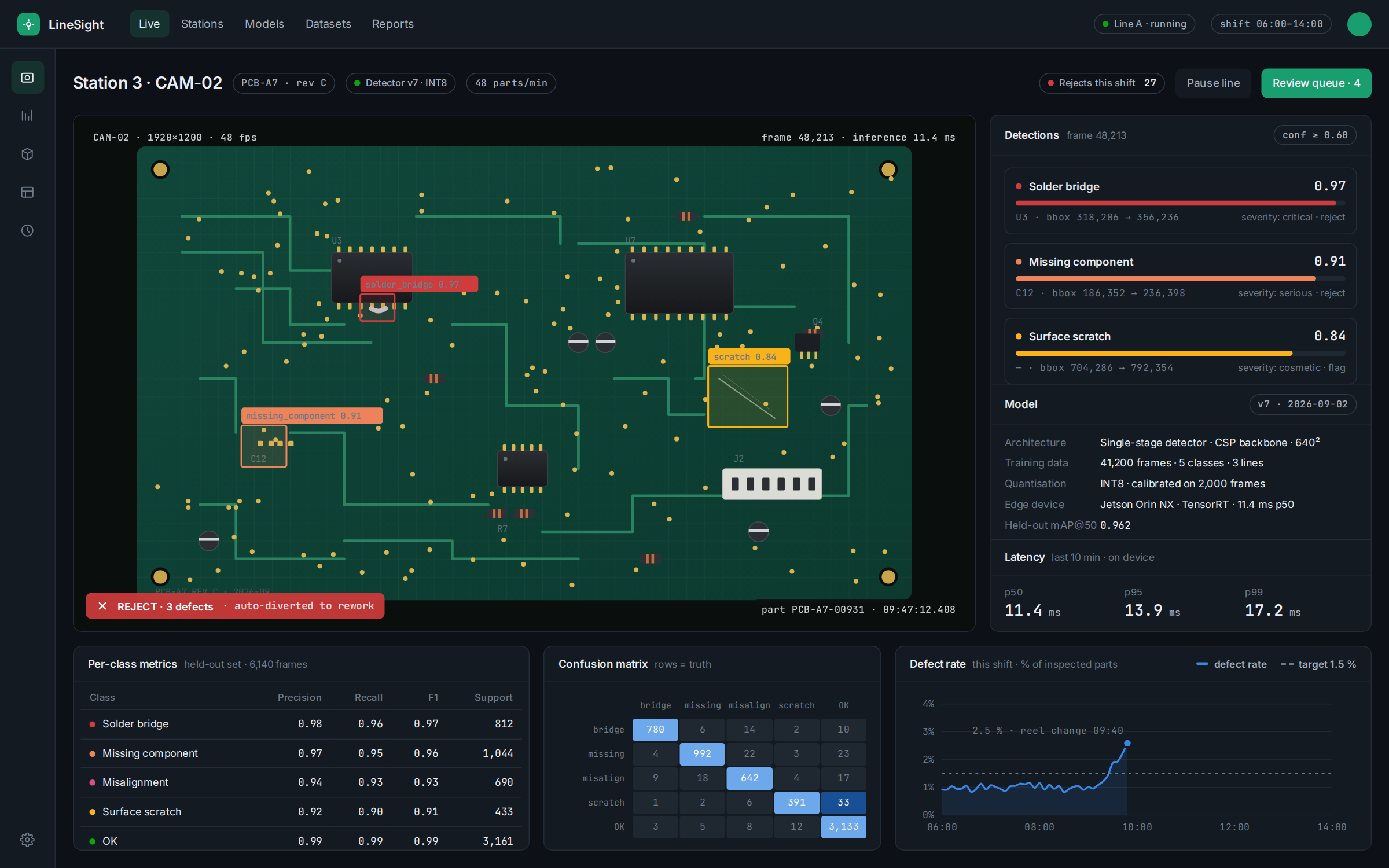
- A single-stage detector trained on 41,200 annotated frames from three production lines, covering solder bridges, missing components, misalignment, surface scratches and the “OK” class.
- Heavy augmentation for lighting, camera angle and board rotation, so the model generalises across stations instead of memorising one camera.
- INT8 quantisation with TensorRT, calibrated on 2,000 representative frames: 11.4 ms median inference on a Jetson Orin NX with no measurable loss in accuracy.
- A live operator view with bounding boxes, confidence and severity, an automatic reject signal to the line PLC, and a review queue for borderline detections that feeds the next training round.
Results
On a held-out set of 6,140 frames the detector reaches 0.962 mAP@50, with per-class precision between 0.92 and 0.99. On the line it inspects 100 % of boards instead of a sample, and the review queue became a flywheel: every operator correction is a new labelled example, and the model has been retrained four times since go-live without touching the hardware.
A new board revision now costs an afternoon of labelling and one training job instead of weeks of threshold tuning.